Your shopping cart is currently empty.
Joseph de Pasquale Interview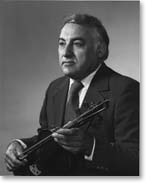
Ovation Press: What inspired you to play the viola?
Joseph De Pasquale: That's a difficult question. I was a violinist first and I was advised to take up the viola because I'm built for it. My hands are fairly large which is good for the viola. That's the reason why I was told I would be very good at the viola.
OP: You come from a very musical family. How involved were your parents in your musical education?
JdP: They both were very involved in our musical education. My father was a violinist and he was very involved with us being successful at what we did. He started my three brothers and I all on the violin with one exception. He started one on the cello because he was dreaming of a string quartet--the De Pasquale String Quartet. We formed this string quartet when I was approximately fifteen years old and played together until just a few years ago.
OP: How important do you feel chamber music is to orchestral musicians?
JdP: I think it is very important to play string quartets because every part is alone and is heard more readily. Because of the number of strings in an orchestra, you can't hear individuals, and so string quartets are very, very important for orchestral musicians to play. It is good for ensemble, good for tone production, good for many aspects of playing, which is very good for the orchestra.
OP: Throughout your career were you able to maintain the De Pasquale String Quartet?
JdP: My brothers William, Francis, and Robert and I had the De Pasquale String Quartet in which we played together for many years until Francis died many years ago and I retired from playing. That was difficult, because I was in Boston, my brother William was the concertmaster of the New Orleans Orchestra, my brother Francis was a member of the Philadelphia Orchestra, and my brother Robert was a member of the New York Philharmonic. We used to get together during the summers as much as we could until eventually we all became members of the Philadelphia Orchestra. We all tried to become a member of the Philadelphia Orchestra. Of course, Ormandy had to like all of us to take all of us which is what happened. That's when we played quartets seriously because we were together in the same city. As quartet musicians it is important to rehearse hours and hours and hours to be as perfect as you can and to come to the point where you think of a musical phrase together as one. Musically you have to play together and it takes hours and hours so that you become accustomed to play with the same musicality and phrasing. Of course, we had differences of opinion but they were resolved in a friendly manner.
OP: What are some of the most important responsibilities of being a principal violist in an orchestra?
JdP: If you're principal, naturally, you have to lead your section. You have to be authoritative. You follow the conductor, of course, and then you have body movements that guide the people in back of you. They observe what you're doing and they will follow you. If I heard a fingering in a passage that I didn't like the sound of, I turned around and told them to change the fingering in a certain spot for a different quality of sound. You have to put in the bowings that you would like. If the conductor likes what you're doing he doesn't bother you. I was never bothered by Mr. Normandy and Mr. Mutti because I put in good bowings and fingerings and they liked what they heard. For example, I always like my section to play a certain passage not on the A string but on the D string for a certain quality of sound that I like and that the conductor likes also. I also played solos and concertos--it's very wonderful for the principal player to play concertos with the orchestra. I was a soloist every year with the Boston Symphony. I was in the Boston Symphony before the Philadelphia Orchestra.
OP: How important are excellent bowings in orchestral music?
JdP: I think bowings are important when there is a solo part for the section. When it's in the turmoil of the orchestral fortissimo, I don't think it matters when you change the bow. Stokowski, the conductor, was very influential in asking people to play different bowings. He was famous for that, but I always thought that in section solos where you have to play with the violins sometimes, we should try to take the same bowings and fingerings.
OP: What are some of the most important lessons you've learned from various conductors over the years?
JdP: I've learned the different interpretations of the master works that they have conducted. Every conductor is different, and you have to follow what they say and what they do if you want to keep playing. They're the supreme boss. Of course they ask "is this bowing all right?", "is this fingering all right?". I may tell them I would rather do the one I suggested, but it doesn't mean they always agree with my choice of fingerings and bowings.
OP: Do you have any stories about the various conductors you would like to share?
JdP: Ormandy was Hungarian and when he came he had difficulty with the English language. He was very funny in the way he tried to explain some of the things that he wanted. We understood what he meant but were amused at what he said many times, and that's the way with many European conductors. They had their problems with English. I was amused many times. I have so many experiences with different conductors--Koussevitzky with the Boston Symphony and Stokowski, Ormandy, and Mutti in the Philadelphia Orchestra. I had wonderful experiences with these conductors.
OP: Which conductors inspired you the most?
JdP: Stokowsky, Ormandy, and Mutti. I thought they had very inspiring interpretations, including what they said and thought about the music and how they explained what they wanted in a certain passage. They also explained the history of the compositions to us.
OP: What have been the biggest changes in orchestras over the years?
JdP: Well, they gained in size. For years and years they only had the small orchestras and then they got large, over a hundred people in an orchestra. In terms of repertoire it is very important to have a balanced program, because you have to have a box office, and if you play all contemporary music, you won't have much of an audience except for the people who love contemporary music.
OP: In your career did you have the opportunity to premiere any concerti?
JdP: Oh, yes. I have a wonderful concerto written for and dedicated to me by Walter Piston, the Harvard composer in Boston. I've played many performances of the Piston. I gave the first performance of the Walton viola concerto in Boston and when I came to Philadelphia, I gave the second performance of the Walton and other works that weren't played too often by principals before me. It was always very exciting to give the first performance of those concertos or works for orchestra.
OP: What advice do you have for a young principal violist starting out for the first time in a new orchestra?
JdP: You have to play damn well! You have to be a fine, wonderfully talented technician and with a beautiful sound. Sound is very important. We were always concerned about the sound in the orchestra. That's why the orchestra is so great. Ormandy and Mutti worked on a sound they liked very much so we had a wonderful sound in the orchestra.
OP: Do you think it is important for today's orchestral musicians to understand and be able to play new contemporary music?
JdP: Of course they have to be trained to play all kinds of music. Not just classical music and the old masters but also the contemporary composers. We have a program at Curtis in which students play a lot of contemporary music, and that's very good for them.
OP: Do you feel that one teacher in particular had an especially large impact on you as a musician?
JdP: Yes. I was influenced greatly by William Primrose. He was a great violist and he inspired me quite a bit in everything--technically, artistically, and with his interpretations. Max Aronoff who was also a wonderful teacher stressed technique quite a bit in my early years. Primrose also stressed technique and played so fantastically that you could not try to imitate him, his artistry or interpretations. You could not do that with an artist of that caliber but I learned quite a bit from him and his great master William Berlioz.
OP: What are your thought on teaching?
JdP: I love to teach young people, especially the really talented ones. I always had wonderful students at the Curtis Institute of Music and also the New England Conservatory when I was involved with the Boston Symphony. Naturally, I try to teach the way I play, I tell students about my experiences with different conductors and about the different interpretations of the concertos which I am teaching them. Also, students should listen to all kinds of repertoire, and that includes different instruments playing that repertoire. They should listen to as many different instruments as possible.
OP: What audition advice do you have for students?
JdP: First of all, you must know the orchestra repertoire. You must work on orchestral pieces just as much as you work on concertos if you want to be an orchestral musician. Or, if you want to be a quartet player work on your quartet parts. If you want to be a soloist you work on your concertos. Not too many soloists emerge in today's world so most of them will eventually become orchestral or quartet musicians and a very select few soloists. I train my students to not only play concertos but also to work on their orchestral parts so that they'll be ready for auditions.
OP: What have you enjoyed the most in your career?
JdP: Playing in the Philadelphia Orchestra and the Boston Symphony were the most wonderful parts of my career. Studying with Aronoff and with Primrose were just great, great experiences for me and playing different concertos with the orchestras, both Boston and Philadelphia, were great experiences for me. I have had so many experiences. All I can say is that I have enjoyed every one of them and it was a great life, a great life to be a musician and to be a member of the Boston and Philadelphia orchestras. I had years of delightful moments playing with my brothers in the De Pasquale String Quartet. Great experiences that I enjoyed very much. It was my whole life.